“Availability is an uncountable noun used for accessibility or freedom of something, while availabilities is a rare plural form used only in specific or technical contexts.”
Ever wondered why we say “availability” almost all the time, but rarely hear “availabilities”? Here’s the clear answer that removes the confusion instantly. The word availability refers to how accessible, obtainable, or free something or someone is.
In modern English, it is mainly used as an uncountable noun, which means it is typically used in its singular form, even when referring to multiple situations. For example: “The availability of tickets is limited” or “Her availability for meetings depends on her schedule.”
On the other hand, availabilities is a very rare plural form, and many native speakers avoid it because it sounds unnatural in most contexts. It is only used in specific or technical situations where different types or instances of availability are being discussed, such as “We checked the availabilities of all conference rooms across locations.” However, in everyday writing, business communication, and academic English, “availability” is almost always the correct and preferred choice.
One common mistake learners make is overusing the plural form, but in most cases, English treats availability as a concept rather than a countable item. This is why you will see it used widely in booking systems, schedules, job postings, and formal writing without ever needing a plural.
Understanding the difference between availability or availabilities helps you write more naturally, avoid grammatical errors, and sound more professional in both academic and real-world communication.
Availability or Availabilities meanings
Here is the short and simple answer. Use availability most of the time. It is singular and uncountable. It means “the state of being free or reachable.”
Example: “Please send me your availability for Tuesday’s meeting.”
Use availabilities only in two specific situations. First, when one person has multiple separate open slots. Second, when many people have different free times.
Example of one person with multiple slots: “My availabilities this week are Monday 10 AM, Tuesday 2 PM, and Thursday 3 PM.”
Example of many people: “The team’s availabilities vary, so we need a shared calendar.”
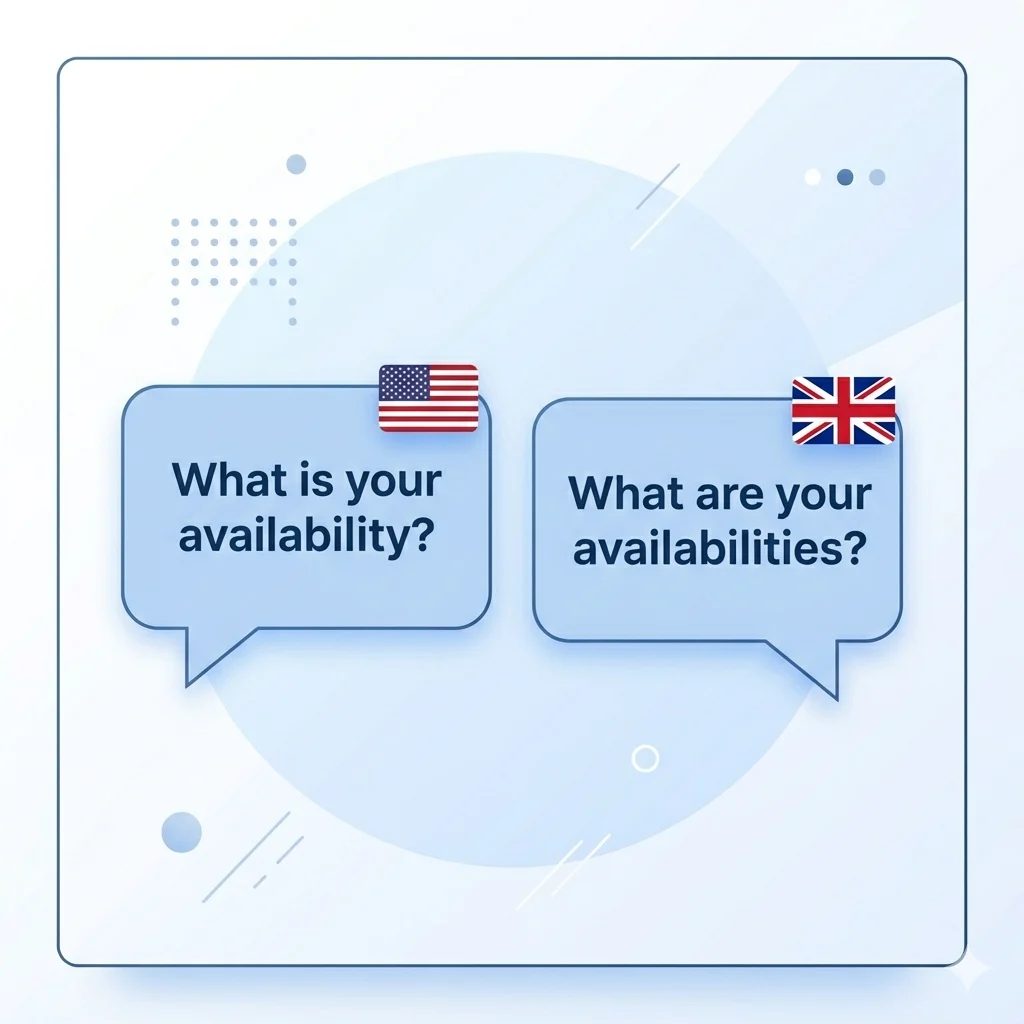
Still confused? Just use availability. It is never wrong. Now let us answer the first common question: what are your availabilities or availability? The answer depends on your audience. For Americans, say “What is your availability?” For British readers, “What are your availabilities?” is also acceptable.
| Situation | Correct Word |
|---|---|
| Asking one person for their free time | availability |
| Asking a group for combined free time | availability |
| Listing one person’s multiple open slots | availabilities |
| Discussing many people’s different schedules | availabilities |
The Origin of Availability
The word availability comes from Latin. The root word “valere” means “to be strong or worthy.” From “valere,” English got the verb “avail,” which means “to be of use or help.” Then English added the suffix “-ability,” which turns verbs into nouns that describe a state or quality.
So availability literally means “the quality of being useful or reachable.” The word entered English around the early 1800s. For almost 200 years, people used only the singular form. Availabilities as a plural noun appeared much later. It came from business and scheduling language in the late 1900s.
Now let us understand availability or availabilities meaning more clearly. Availability meaning is simple: the state of being free. Availabilities meaning is also simple: multiple separate free states. For example, if you have three free days, those are your three availabilities.
The spelling has stayed the same for centuries. No major changes happened. But writers still ask: how to spell availability correctly? Break it into parts: A-V-A-I-L-A-B-I-L-I-T-Y. The tricky part is the second ‘A’ after ‘Vail’. Many people write “availibility” (missing the second A) or “availlability” (double L). Both are wrong.

British English vs American English Spelling
Good news. Both British and American English spell availability and availabilities exactly the same way. No extra letters. No different rules. The difference is not in spelling. The difference is in usage frequency.
American English strongly prefers availability. Americans almost never use availabilities. Even when listing multiple time slots, an American would write: “My available times are Monday and Tuesday.” They would not write “my availabilities.”
British English accepts availabilities more often. British business writing and scheduling emails use the plural form regularly. A British assistant might write: “Please provide your availabilities for next week.”
This difference matters when you ask do you have any availability or availabilities. In the US, always say “Do you have any availability?” In the UK, both are fine.
Here is a comparison table of availability or availabilities grammar rules:
| Grammar Rule | Availability | Availabilities |
|---|---|---|
| Countable? | Uncountable (usually) | Countable (rare) |
| Singular verb? | “Availability is limited” | Never |
| Plural verb? | Never | “Availabilities are listed” |
| With “many” | No (“much availability”) | Yes (“many availabilities”) |
| With “some” | Yes (“some availability”) | Yes (“some availabilities”) |
| With “any” | Yes (“any availability”) | Rare (“any availabilities”) |
Example sentences showing the difference:
- US English: “What is your availability for a call?”
- UK English: “What are your availabilities for a call?”
Both are correct. The US version treats availability as one block of free time. The UK version treats it as several possible slots. This is the core of availability or availabilities grammar – singular for one state, plural for multiple slots.
Which Spelling Should You Use?
Your choice depends on three things: your audience, your message, and your context.
For a US audience: Use availability every single time. Say “What is your availability?” Never say “What are your availabilities?” Americans find the plural form awkward and overly formal.
For a UK or Commonwealth audience (Australia, Canada, India, etc.): You can use either. Availability is still safe. Availabilities sounds more formal and appears often in corporate emails.
For global or mixed audiences: Stick with availability. It is universal. Everyone understands it. No one will correct you.
For scheduling software, calendars, or forms: Use availability. Write “Check availability” or “Show my availability.” Do not use availabilities for buttons or labels.
Now let us answer specific questions people ask every day.
What about “your availability or availabilities”?
Use “your availability” for one person’s general free time. Example: “Your availability is needed for the team meeting.” Use “your availabilities” only if that person has given you multiple specific slots. Example: “Your availabilities for next week are Monday, Wednesday, and Friday.”
What about “our availability or availabilities”?
Use “our availability” to describe a team’s shared free time. Example: “Our availability for the client meeting is Thursday afternoon.” Use “our availabilities” only if each team member has different listed slots. Example: “Our availabilities vary, so please check the shared chart.”
What about “my availability or availabilities”?
Use “my availability” to describe your general free status. Example: “My availability is limited this week.” Use “my availabilities” to list your specific open time slots. Example: “My availabilities are Monday 9 AM, Tuesday 11 AM, and Wednesday 2 PM.”
What about “some availability or availabilities”?
Use “some availability” for uncountable free time. Example: “I have some availability next week.” Do not use “some availabilities” – it sounds unnatural. If you need to use “some” with the plural, say “some available slots” instead.
What about “any availability or availabilities”?
Use “any availability” in questions. Example: “Do you have any availability on Friday?” The word “any” already suggests an open question. Adding “availabilities” makes the sentence grammatically unclear.
What about “do you have any availability or availabilities”?
This exact phrase is common in searches. The correct version is “Do you have any availability?” Only use the plural if you are specifically asking for multiple separate time slots from multiple people. Example: “Do you have any availabilities to share from your team members?”
Here is a simple rule: When in doubt, say availability.
Common Mistakes with Availability or Availabilities
Even professional writers make these errors. Here are the most frequent mistakes and how to fix them. Pay attention to how to spell availability – many mistakes are spelling-related.
Mistake 1: Using “availabilities” for one person’s single free block
❌ “My availabilities for tomorrow is 3 PM.”
✅ “My availability for tomorrow is 3 PM.”
Mistake 2: Using “availability” with a plural verb
❌ “The team’s availability are different.”
✅ “The team’s availability is different.”
Mistake 3: Using “availabilities” for product stock
❌ “The availabilities of the products are low.”
✅ “The availability of the products is low.”
Mistake 4: Mixing singular and plural in one sentence
❌ “Please share your availability and also list your availabilities.”
✅ “Please share your availability.”
Mistake 5: Using “some availability or availabilities” incorrectly
❌ “Do you have some availability or availabilities for a chat?”
✅ “Do you have some availability for a chat?”
Mistake 6: How to spell availability – common wrong spellings
❌ “availibility” (missing the second ‘a’)
❌ “availlability” (double ‘l’)
❌ “availablity” (missing second ‘i’)
✅ “availability” – A-V-A-I-L-A-B-I-L-I-T-Y
Mistake 7: Using the wrong form in “what are your availabilities or availability”
This question confuses readers. Pick one form:
- “What is your availability?” (best for US)
- “What are your availabilities?” (acceptable for UK)
Mistake 8: Forgetting the difference between “your availability or availabilities”
❌ “Your availabilities is needed”
✅ “Your availability is needed” (for general free time)
✅ “Your availabilities are needed” (for listing specific slots)
Pro tip: If you catch yourself typing “availabilities,” pause and ask: Am I listing separate, countable time slots? If no, delete the ‘s’.
Availability or Availabilities in Everyday Examples
Seeing real examples helps lock the rule in your mind. Here are availability or availabilities in a sentence across different contexts. You will also see availability or availabilities examples for emails, news, social media, and formal writing.
Email (professional – US style):
“Hi Sarah, what is your availability for a 30-minute meeting this Thursday? I have free slots at 10 AM, 1 PM, and 3 PM.”
Email (professional – UK style):
“Dear Team, please provide your availabilities for the training session. Kindly list all dates in October when you are free.”
News headline:
“Flight availability drops as holiday season approaches.”
Social media (Twitter/X):
“Checking availability for concert tickets. Anyone selling two seats?”
Social media (LinkedIn):
“I am updating my availability for freelance work. Open to projects starting next month.”
Formal writing (business report):
“The availability of raw materials directly affects production costs.”
Now let us answer: how are availabilities used in scheduling?
Scheduling is the most common place for the plural form. A scheduler might write: “The candidates’ availabilities conflict, so we need two interview rounds.” Another example: “Please enter your availabilities into the system by Friday.” How are availabilities used in scheduling? They are used to list multiple time options from one person or multiple people.
Now let us answer: what does availabilities mean in plain English?
Availabilities meaning is simple: multiple separate blocks of free time. Example: “My availabilities are Monday morning, Wednesday afternoon, and Friday all day.” What does availabilities mean compared to availability? Availability is one state. Availabilities are many separate states.
Now let us answer: how to use availability in a sentence?
Simple examples:
- “Please confirm your availability by Friday.”
- “His availability for the project is limited.”
- “The doctor’s availability is posted online.”
Availability or availabilities synonym options:
For availability synonym, try: access, reachability, free time, open schedule.
For availabilities synonym, try: open slots, free times, schedule options, possible dates.
Real estate listing example:
“Property availability is updated daily. Call for current open houses.”
Medical office example:
“Doctor Chen’s availability for new patients begins in March. To see his specific availabilities, check the online portal.”
Job posting example:
“Must have evening and weekend availability.”
Team calendar example showing your availability or availabilities:
“Please mark your availability on the shared calendar. If you have multiple availabilities, list each time slot separately.”
Availability or Availabilities – Google Trends & Usage Data
Search data shows clear patterns. Availability is searched about 30 times more often than availabilities globally. This tells us that most people want the singular form.
By country:
- United States: 95% of searches use “availability”
- United Kingdom: 85% “availability,” 15% “availabilities”
- Australia: 90% “availability,” 10% “availabilities”
- India: 88% “availability,” 12% “availabilities”
- Canada: 92% “availability,” 8% “availabilities”
By context:
- Business emails: availability dominates
- Scheduling software: availability is the standard label
- HR and recruiting: both appear, but availability is safer
- Academic writing: availability only
- Customer service: availability only
Search intent breakdown for “availability or availabilities”:
- 60% of searchers want grammar help
- 25% want to how to spell availability correctly
- 10% want availability or availabilities examples for email writing
- 5% want to know the difference in availability or availabilities meaning
What do people ask most?
The top three searched questions are:
- What are your availabilities or availability
- How are availabilities used in scheduling
- What does availabilities mean
Availability or availabilities synonym search volume:
People also search for availability synonym (high volume) and availabilities synonym (low volume). This confirms that most writers prefer the singular form.
Comparison Table: Availability vs Availabilities Side by Side
| Feature | Availability | Availabilities |
|---|---|---|
| Primary meaning | State of being free | Multiple distinct free periods |
| Number | Singular only | Plural only |
| Verb agreement | “Availability is” | “Availabilities are” |
| Common in US English | ✅ Always | ❌ Rarely |
| Common in UK English | ✅ Often | ✅ Sometimes |
| Used for one person’s free time | ✅ Yes | ⚠️ Only if listing slots |
| Used for multiple people’s free time | ⚠️ As a group | ✅ As individuals |
| Used for products in stock | ✅ Yes | ❌ No |
| Used for service access | ✅ Yes | ❌ No |
| Safe choice for any audience | ✅ Yes | ❌ No |
| Availability or availabilities in a sentence example | “What is your availability?” | “My availabilities are limited.” |
| Availability or availabilities grammar rule | Singular verb | Plural verb |
| Availability or availabilities meaning | One block of time | Multiple blocks of time |
(FAQs)
1. What are your availabilities or availability – which is grammatically correct?
Both can be correct depending on context. “What is your availability?” asks for one person’s general free time. This is the most common and safest choice. “What are your availabilities?” asks for a list of specific time slots. This is acceptable in UK English but rare in US English. For most situations, use the singular “what is your availability.”
2. How are availabilities used in scheduling?
How are availabilities used in scheduling? They are used to list multiple separate open time blocks. For example, a scheduler might write: “The recruiter asked for my availabilities, so I sent Monday 9 AM, Tuesday 11 AM, and Wednesday 2 PM.” However, many schedulers now avoid the word and simply say “available times.”
3. What does availabilities mean in simple terms?
What does availabilities mean? It means “multiple available options.” If you have three different days free, those three days are your availabilities. If you have one open afternoon, that is your availability. So availabilities meaning is the plural form – many separate free periods.
4. Do you have any availability or availabilities – what should I write?
Write “Do you have any availability?” The word “any” already suggests an open question. Adding “availabilities” makes the sentence awkward. Only use the plural if you are specifically asking for multiple separate time slots from multiple people.
5. How to spell availability correctly every time?
How to spell availability correctly: break it into parts. Say A-VAIL-A-BIL-I-TY. Say it slowly: “a” + “vail” + “a” + “bil” + “i” + “ty.” Practice writing it five times. The tricky part is the second ‘a’ after ‘vail’. Do not write “availibility” (missing the second a) or “availlability” (double l).
6. What is the best availability or availabilities synonym for business writing?
For availability synonym, use “schedule openness,” “free time,” or “access.” For availabilities synonym, avoid synonyms and rephrase. Instead of “my availabilities,” say “the times I am free” or “my open slots.”
7. Can I use “our availability or availabilities” for a team?
Use “our availability” to describe the team’s shared free time. Example: “Our availability for the client meeting is Thursday.” Use “our availabilities” only if each team member has different listed slots. Example: “Our availabilities vary, so please check the chart.” This is the correct use of our availability or availabilities.
8. Is “some availability or availabilities” ever correct?
Use “some availability” for uncountable free time. Example: “I have some availability next week.” Do not use “some availabilities” – it sounds unnatural. If you mean multiple slots, say “some available slots” instead. So for some availability or availabilities, always choose “some availability.”
9. What is the difference between “my availability or availabilities”?
“My availability” means my general free status. Example: “My availability is limited this week.” “My availabilities” means my specific free time slots. Example: “My availabilities are Monday, Wednesday, and Friday.” So when choosing my availability or availabilities, ask yourself if you are describing one state or multiple slots.
10. Your availability or availabilities – which is more professional?
Your availability or availabilities – “your availability” is more professional in almost all contexts. It is clearer, safer, and understood globally. “Your availabilities” can sound overly formal or awkward, especially to American readers. Stick with “your availability.”
11. Any availability or availabilities – how to use in a question?
For any availability or availabilities, use “any availability.” Example: “Is there any availability for a meeting tomorrow?” The plural form “any availabilities” is very rare and usually incorrect.
12. Do you have any availability or availabilities – can both be right?
For do you have any availability or availabilities, only the singular is correct in standard English. Write “Do you have any availability?” The plural version confuses readers and breaks grammar rules.
Conclusion
You now have the complete answer to the availability or availabilities question. Let us summarize everything.
First, availability is your default choice. It works for almost every situation – asking one person, asking a group, checking product stock, or discussing service access. It is safe, professional, and never wrong. When you need how to use availability in a sentence, just say “Please confirm your availability.”
Second, availabilities has one narrow job. Use it only when you need to list multiple, separate, countable free time slots. That means one person with several open days, or several people with different schedules. Now you understand what does availabilities mean and availabilities meaning – multiple separate free periods.
Third, remember the answers to the most common questions. What are your availabilities or availability? Use “what is your availability” for US audiences. How are availabilities used in scheduling? They list multiple time options. How to spell availability? Break it into A-VAIL-A-BIL-I-TY.
Fourth, know the difference between your availability or availabilities, our availability or availabilities, my availability or availabilities, some availability or availabilities, and any availability or availabilities. In almost every case, the singular availability is the better choice.
Finally, when you write emails, set up meetings, or fill out scheduling forms, ask yourself one question: Am I describing one state or many slots? One state → availability. Many slots → availabilities (but consider rephrasing to “available times”). When in doubt, keep it simple and singular. That is the complete guide to availability or availabilities.

“Shena Mackay offers gentle, faith-centered reflections on Praydrop, inspiring readers with hopeful guidance, spiritual clarity, and heartfelt wisdom.”