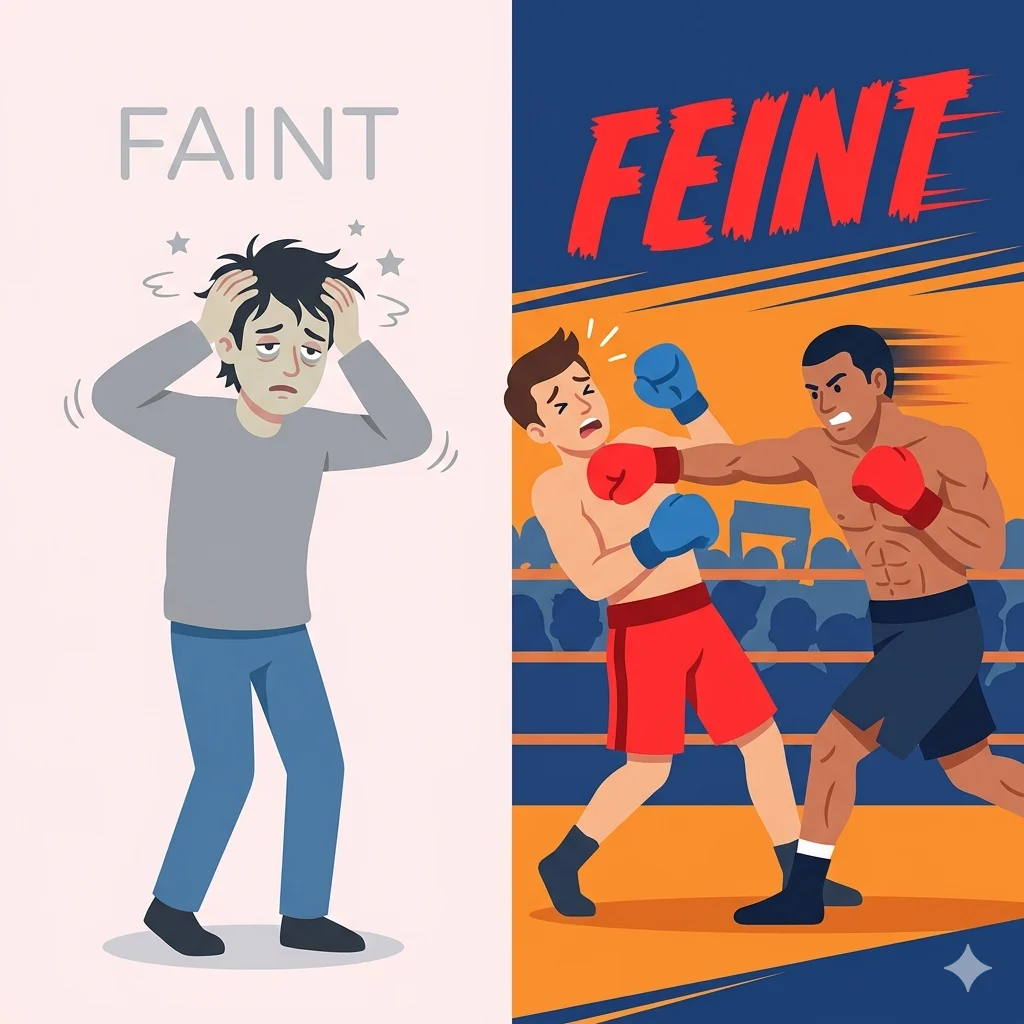
“Faint means to lose consciousness, while feint is a fake or deceptive move; both words sound similar but have completely different meanings.”
Confused between “faint” and “feint”? One small mistake can completely change your sentence! These two words sound similar but have very different meanings and uses. Faint means to lose consciousness or feel weak, often due to heat, stress, or exhaustion.
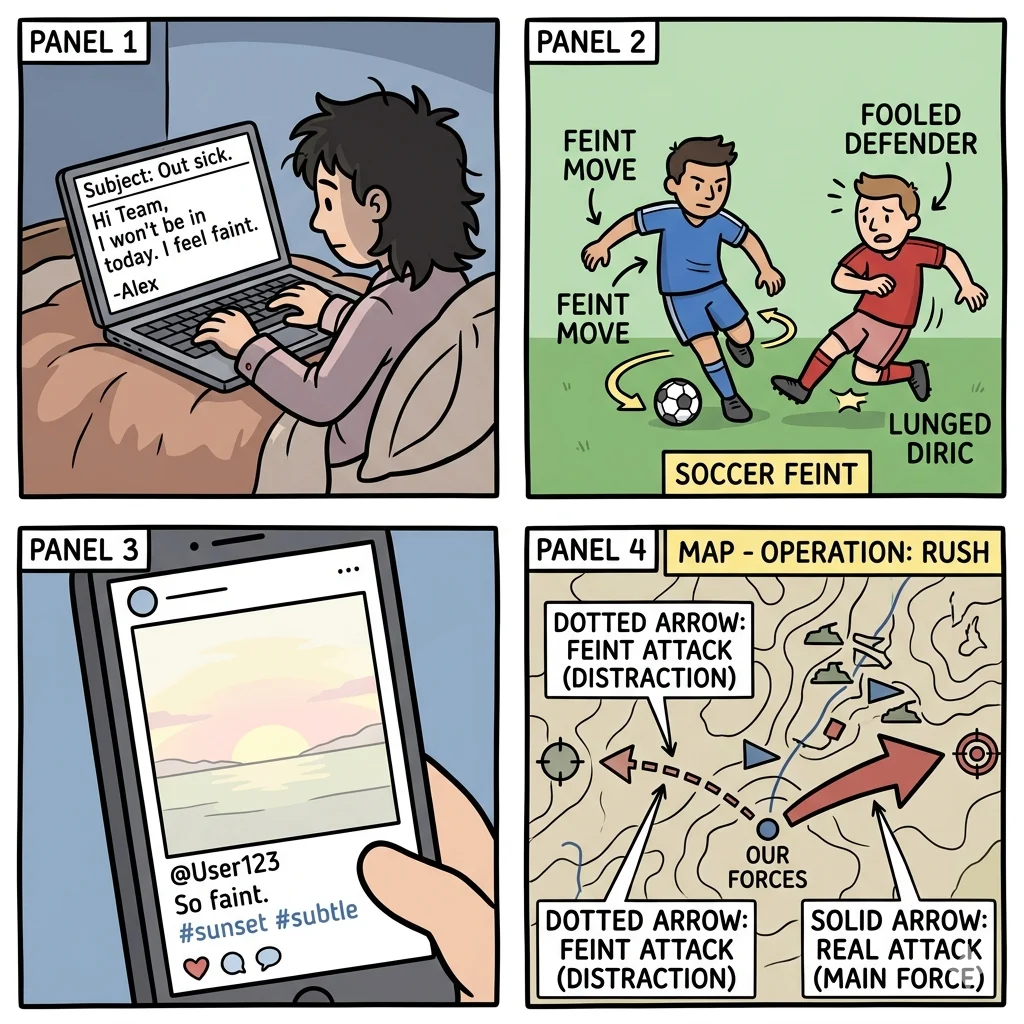
In contrast, feint is a deceptive move, commonly used in sports or fighting, where you pretend to act in order to trick someone. For example, “She fainted in the heat” or “He nearly fainted after the long run” describe physical reactions, while “The boxer made a feint to the left” or “He used a quick feint to confuse his opponent” show intentional trickery.
In this guide, you’ll learn the exact difference between faint vs feint, along with simple examples and usage tips to avoid common mistakes. If you want to write clearly and confidently, understanding faint vs feint is essential.
Faint or Feint meanings
Faint means weak, dizzy, or barely there. Feint means a fake move to trick someone.
- Faint example: “The writing was so small it was faint.” (Hard to see)
- Feint example: “The boxer used a feint to confuse his opponent.” (Fake punch)
If you ask what is the difference between faint and feint? Here it is: one is about feeling weak or pale. The other is about pretending. Remember this: Faint has an ‘a’ like ‘awake’. Feint has an ‘e’ like ‘fake’. That is the best faint or feint synonym trick.
The Origin of Faint or Feint
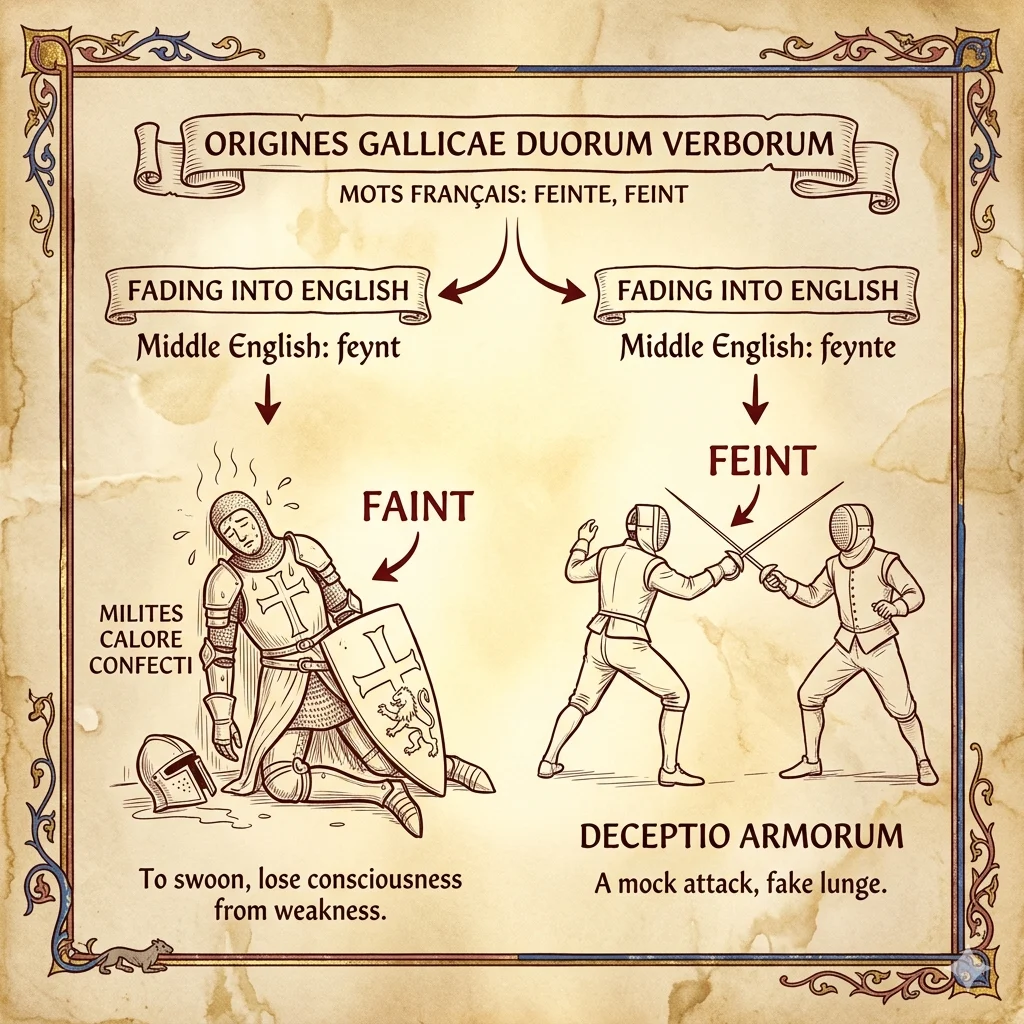
Words have history. Faint came from old French. It meant “to be lazy or weak.” Later, it described people who pass out. It also described colors that are pale. A faint or feint colour is light and soft.
Feint also came from old French. But it came from a word meaning “to pretend or disguise.” Soldiers and fencers used feints. They would fake an attack. Then do a real one.
Why do spelling differences exist? English took both words from French. But they had different jobs. One was for health. One was for tricks. Over time, people forgot the difference. Now, even smart writers mix them up. Knowing the origin helps you choose the right word forever.
British English vs American English Spelling
Here is good news. The spelling does not change between British and American English. Faint is always faint. Feint is always feint. Both countries use the same spelling. But they use the words in different amounts.
Americans use faint more for health. “I feel faint.” Brits use faint for colors and smells. “A faint or feint smell of rain.” Both use feint for sports and military.
Here is a comparison table for spelling rules.
| Word | British Meaning | American Meaning | Spelling Rule |
|---|---|---|---|
| Faint | Weak, dizzy, pale, slight | Same | Never changes |
| Feint | Fake move in sports or war | Same | Never changes |
| Faint line | Barely visible line on a test | Same | Always faint, never feint |
| Feint writing | Fake or deceptive handwriting | Same | Rare; use feint |
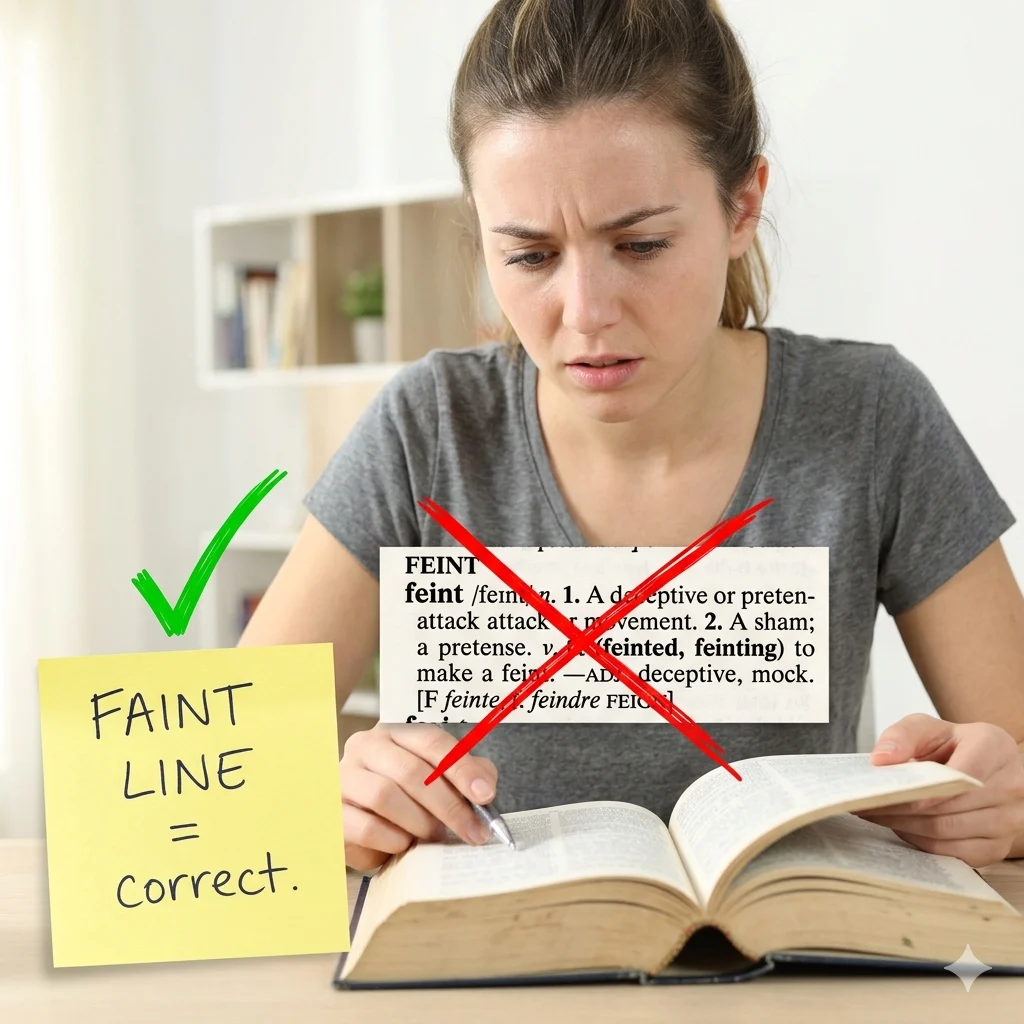
So how do you spell faint line? You spell it F-A-I-N-T. A feint line does not exist. That would mean a fake line. That is not correct.
Dissociating or Disassociating? The Shocking Secret Exposed! ⚡
Which Spelling Should You Use?
This depends on your reader. Use this audience-based advice.
- For US readers: Use faint for health and vision. “The sign was faint.” Use feint for sports. “The basketball player made a feint.”
- For UK and Commonwealth readers: Same rules. But you will see feint more in fencing and military history.
- For global readers: Keep it simple. Ask yourself: Is it real weakness? Use faint. Is it a fake trick? Use feint.
If you write for business or school, never guess. If you mean “barely there,” it is faint. If you mean “fake attack,” it is feint. The phrase faint of heart is always faint. It means people who are too weak or scared. Is it faint or feint of heart? It is faint of heart. Always.
Common Mistakes with Faint or Feint
Here are the most frequent errors people make. And how to fix them.
- Mistake: Writing “feint line” on a pregnancy test.
- Correction: “Faint line.” A faint line is hard to see. A feint line has no meaning.
- Mistake: “He made a faint to the left.”
- Correction: “He made a feint to the left.” A fake move.
- Mistake: “The smell was feint.”
- Correction: “The smell was faint.” Weak smell.
- Mistake: Using faint or feint meaning wrong in a dictionary search.
- Correction: Remember: Faint = weak. Feint = fake.
- Mistake: Wrong feint vs faint pronunciation.
- Fix: Both sound exactly the same. Rhyme with “paint.” So context is everything.
Also, feint writing is a rare mistake. Some think it means light handwriting. No. Light handwriting is faint writing. Feint writing would mean fake or deceptive writing. Only use that if you mean a lie on paper.
Unattentive or Inattentive? The Shocking Truth You’re Missing 🤯
Faint or Feint in Everyday Examples
See these words in real life. Use these examples for your own writing.
Emails:
- “The scan showed a faint shadow. We need another test.”
- “His excuse was a feint to avoid the meeting.”
News Headlines:
- “Faint hope remains for the lost hikers.”
- “General’s attack was just a feint; real army came from the east.”
Social Media:
- “Omg this line is so faint! Do you see it?” (Pregnancy test)
- “That dribble move was a perfect feint. He faked me out!”
Formal Writing:
- “The patient reported feeling faint after standing up.”
- “The military used a feint to draw enemy fire.”
Using both in a sentence: “After a faint cry for help, the hero made a feint to the right, tricking the guard.” This shows faint and feint in a sentence perfectly.
Faint or Feint – Google Trends & Usage Data
Search data shows faint is much more common. Why? People use it every day. For health, colors, smells, and sounds. Feint is rare. It is mostly used in sports writing, military history, and gaming.
- By country: The US searches faint more for medical reasons. The UK searches faint more for weather and smells (“faint scent”). Canada and Australia follow the UK pattern.
- By context: Faint line is a top search. Many people ask how do you spell faint line after a home test. Feint spikes during the Olympics (fencing) and football season (fake passes).
- By time: Feint searches go up when a new video game has a “feint” button. Faint searches go up during flu season or allergy season (faint smells).
The data proves one thing. If you are not sure, choose faint. It is 10 times more common. But if you mean a trick in sports or war, feint is the only correct word.
Comparison Table: Faint vs Feint Side by Side
| Feature | Faint | Feint |
|---|---|---|
| Part of Speech | Adjective, verb, noun | Noun, verb |
| Primary Meaning | Weak, dizzy, barely visible or audible | A fake or deceptive move |
| Common Synonyms | Pale, slight, dim, weak, dizzy | Trick, fake, bluff, deception |
| Example Sentence | “The faint light hurt my eyes.” | “His punch was a feint.” |
| Common Phrases | Faint of heart, faint line, faint hope | Feint attack, feint move |
| Pronunciation | Rhymes with “paint” | Rhymes with “paint” |
| Spelling Trick | Has an ‘a’ like actual weakness | Has an ‘e’ like fake |
Use this table when you need a faint or feint synonym quickly. For feint synonym, use “bluff” or “fake.” For faint synonym, use “weak” or “pale.”
(FAQs)
1. What is the difference between faint and feint?
Faint means weak, dizzy, or not strong. Feint means a fake move to trick someone. One is real weakness. The other is a fake action.
2. How do you spell faint line?
You spell it F-A-I-N-T line. A faint line is a line that is hard to see. Never use feint for a line.
3. Is it faint or feint of heart?
It is faint of heart. This phrase means people who are easily scared or too weak to do something hard. For example: “This roller coaster is not for the faint of heart.”
4. What is faint or feint meaning in simple words?
Faint meaning: Barely there or about to pass out. Feint meaning: A pretend punch or move.
5. Give me a faint or feint synonym.
For faint: weak, pale, dim, slight. For feint: fake, bluff, trick, deception.
6. What does faint or feint colour mean?
Faint colour means a color that is very light, like pale pink. Feint colour is wrong. Do not use it.
7. What is faint or feint smell?
Faint smell means a weak odor you can barely notice. Feint smell is incorrect.
8. Can you give faint and feint in a sentence together?
Yes: “The soldier felt a faint pain in his leg, but he used a feint to fool the enemy.”
9. What is feint vs faint pronunciation?
They sound exactly the same. Say “fay-nt.” You must use the sentence to know which word is meant.
10. What is feint writing?
Feint writing is very rare. It means writing that is fake or meant to deceive. For normal light writing, say faint writing.
Conclusion
Now you know the difference. Faint is for things that are weak, pale, dizzy, or hard to see. Feint is for fake moves in sports, fights, or war. Most people only need faint in daily life. You will use it for smells, colors, sounds, and feeling sick. Use feint only when someone is pretending to do one thing but actually doing another.
Remember the trick: Faint has an ‘a’ like ‘actual’. Feint has an ‘e’ like ‘fake’. When you write, ask yourself: Is this real weakness? Then use faint. Is this a trick? Then use feint. Never mix them again. For faint of heart, always use faint. For a faint line on a test, always use faint. You are now better than most writers. Go use your new skill.

“Charles Williams writes uplifting spiritual insights for Praydrop, inspiring readers with faith, hope, and guidance for a more peaceful, meaningful life.”