Insight or Insite: The main difference is that insight is the correct English word that means deep understanding, clear perception, or the ability to understand someone or something clearly, while insite is usually a misspelling and is only correct when used as the name of a company, brand, product, software, or website.
Many people get confused when choosing between insight or insite because both words sound exactly the same. This is one of the most common English spelling mistakes, and using the wrong spelling can make your writing look less accurate and professional. Learning the difference is easier than you might think, and once you understand the rule, you’ll never confuse these words again.
Use insight whenever you’re talking about wisdom, understanding, perception, knowledge, or the ability to recognize the true meaning of something. For example, “Her insight helped the team solve the problem.” Use insite only when it is part of an official company, brand, software, product, or website name. In standard English, it is generally considered an incorrect spelling.
Although the difference between insight or insite seems small, choosing the correct word can improve the clarity, credibility, and professionalism of your writing. Whether you’re writing an essay, email, blog post, business document, or social media content, using the right spelling helps you communicate with confidence and avoid a common English mistake.
In this complete guide, you’ll learn the exact difference between insight and insite, their meanings, pronunciation, grammar, dictionary usage, and correct spelling. You’ll also discover real-life examples, common mistakes, simple memory tricks, and expert writing tips to help you remember the correct word every time. By the end of this article, you’ll know exactly when to use insight and why insite is usually incorrect.
Insight meaning
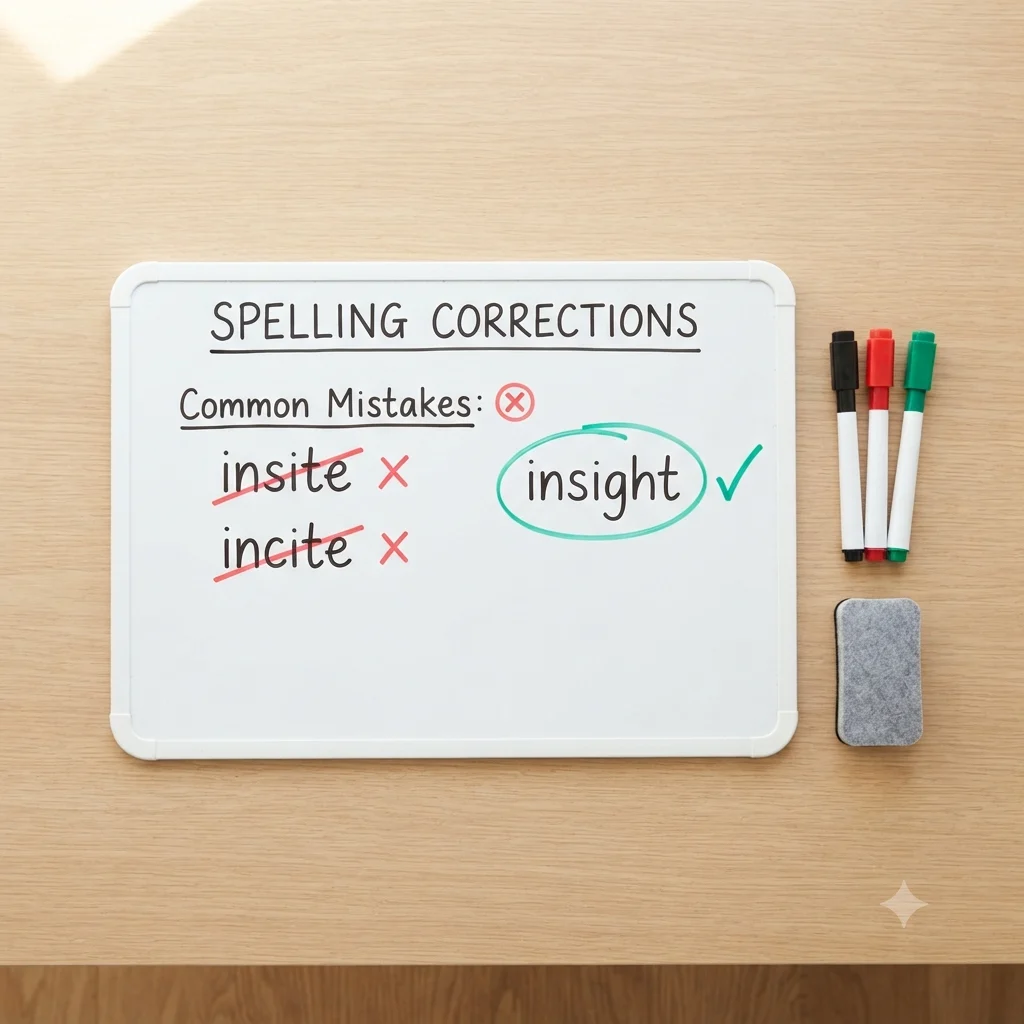
The correct spelling is insight. “Insite” is not a standard English word. It is almost always a spelling error.
Insight is a noun. It means a deep, clear understanding of a person, situation, or problem. It is the ability to see into something and grasp its true nature.
Examples:
- “Her insight into the market helped the company grow.”
- “The teacher gave us valuable insight into the subject.”
- “He gained insight after reflecting on his mistakes.”
Whenever you are asking “is it insight or insite,” the answer is always insight for proper English. The word “insite” does not appear in standard dictionaries. Some companies use “Insite” as a brand name, but this is rare. In everyday writing, you should always choose insight.
The Origin of Insight
To fully understand this word, let us explore its history. Insight comes from two parts. The prefix “in-” means “into.” The root “sight” comes from Old English “siht,” which means “vision” or “seeing.” So insight literally means “seeing into” something.
The word has been in use for over 800 years. Its meaning has remained consistent throughout history. It always referred to the ability to see deeply into a matter. This is different from simple seeing. Sight is physical. Insight is mental and emotional. It is about understanding, not just observing.
The spelling has stayed stable over centuries. No major variations existed until modern times. The confusion with “insite” is a recent problem. It likely comes from the way we pronounce the word. Since both “insight” and “insite” sound identical, people guess the spelling. They often choose the simpler spelling “insite” by mistake. But the historical and correct form is always insight.

British English vs American English Spelling
When discussing “insight or insite grammar,” it helps to look at spelling rules. Here is good news for you. There is no difference between British and American English for this word. Both use insight as the standard spelling.
The confusion comes from other similar words. For example, “site” means a place or location. “Sight” means vision or seeing. When people write “insite,” they are often confusing it with “site.” This is a spelling error, not a regional difference.
Comparison Table of Variations
| Term | Correct Spelling | Meaning |
|---|---|---|
| Insight | Yes | Deep understanding |
| Insite | No | Common misspelling of insight |
| Sight | Yes | The ability to see |
| Site | Yes | A location or website |
| Incite | Yes | To provoke or stir up action |
| In sight | Yes | Visible or within view |
This table clearly shows that “insight” and “insite” are not both correct. One is a real word with meaning. The other is a mistake. Understanding this difference helps you choose the right word every time.
Which Spelling Should You Use?
The advice here is simple. You should always use insight in all forms of writing. This rule applies whether you are in the US, UK, Canada, Australia, or any other English-speaking country.
Here is a breakdown by audience:
For US Audiences: Use insight. American English has no alternative spelling. Every style guide recommends insight.
For UK and Commonwealth Audiences: Use insight. British English also uses insight exclusively. There is no British variant.
For Global and International Writing: Use insight. This is the standard across all English dialects.
For Professional Contexts: Always use insight. Emails, reports, presentations, and academic papers require the correct spelling.
For Social Media and Casual Writing: Still use insight. Even in informal settings, correct spelling shows care and attention.
So if you are ever unsure and wondering “what is the difference between insite and insight,” remember that only one is a real word. Insight is correct. Insite is an error.
Common Mistakes with Insight
Many people make simple errors with this word. Let us look at the most common mistakes and how to fix them.
Mistake 1: Using “insite” instead of “insight”
- Incorrect: “She gave me a great insite.”
- Correct: “She gave me a great insight.”
Mistake 2: Confusing “insight” with “incite”
- Insight means understanding.
- Incite means to provoke or encourage. For example, “His words incited anger.”
- These have completely different meanings. Understanding what does it mean to insite someone is actually asking about “incite,” not “insight.”
Mistake 3: Using “in sight” when you mean “insight”
- “In sight” means visible. For example, “The finish line is in sight.”
- “Insight” means understanding. For example, “He has insight into the problem.”
- These are not interchangeable.
Mistake 4: Misspelling in compound forms
- Incorrect: “insightful” spelled as “insiteful”
- Correct: “insightful” (meaning showing deep understanding)
Mistake 5: Using insight as a verb
- Insight is only a noun. You cannot “insight” something.
- Correct usage: “gain insight,” “offer insight,” “provide insight”
Insight in Everyday Examples
Understanding “insight or insite in a sentence” is easier with real-world examples. Let us see how insight appears in different contexts.
In Emails:
- “Thank you for your insight on this project.”
- “I would appreciate your insight into the new policy.”
- “Your feedback gave me valuable insight.”
In News Headlines:
- “Experts offer insight into economic trends.”
- “New study provides insight into mental health.”
- “The report reveals surprising insight about consumer behavior.”
On Social Media:
- “Here is my insight on today’s biggest news.”
- “Share your insight in the comments below.”
- “This video gave me a new insight about productivity.”
In Formal Writing:
- “The research provides insight into the causes of climate change.”
- “Her insight into human behavior is remarkable.”
- “This theory offers insight into cultural differences.”
In Everyday Conversation:
- “I had an insight about my career path.”
- “Can you give me some insight on this matter?”
- “His insight changed how I see the situation.”
Notice that each example uses insight to describe understanding or clarity. You never see “insite” in these examples because it is not a real word.

Insight – Google Trends & Usage Data
If you look at how people search for this word, you will see interesting patterns. “Insight or insite” is a very common search query. Many people are unsure about the correct spelling.
Popularity by Country:
- The search for “insight” is highest in the United States.
- The United Kingdom also shows strong search volume.
- Australia, Canada, and New Zealand follow closely.
- The misspelling “insite” is searched most in regions where English is a second language.
Context of Use:
- Insight appears most in business and academic contexts.
- It is heavily used in marketing, psychology, and self-help.
- The word is popular in blog posts and professional articles.
- The misspelling “insite” appears more in casual writing and social media.
Trends Over Time:
- The use of “insight” has steadily increased over the years.
- The confusion with “insite” has also grown due to phonetic spelling.
- However, proper usage remains consistent in edited publications.
This data shows that while many people search for “insight or insite,” professional and formal writing always uses the correct form.
Frequently Asked Questions
What is the difference between insite and insight?
The difference is simple. Insight is a real word meaning deep understanding. Insite is a common misspelling. It has no standard meaning in English. Always use insight.
What is the meaning of insite?
Insite does not have a standard dictionary meaning. It is a misspelling of insight. Some companies use “Insite” as a brand name, but this is rare. In everyday writing, it is considered an error.
What is the difference between insight and insight?
This question likely means “what is the difference between insight and insite?” The answer is that insight is correct and insite is a mistake. There is no difference between insight and itself.
What does it mean to insite someone?
This is a common confusion. The word you are looking for is “incite.” To incite someone means to provoke or encourage them to do something, often something negative. Insight is not used as a verb.
Insight or insite meaning
The meaning of insight is a deep, clear understanding of something. Insite has no real meaning. It is simply a misspelling. If you see “insite,” it is almost always meant to be insight.
Insight or insite grammar
In proper grammar, insight is the only correct choice. Insite is not recognized in standard English grammar. It is a spelling error. Use insight in all cases.
What are insight or insite examples?
Good examples of insight include: “She gained insight into the market.” “His insight solved the problem.” Examples of insite do not exist because it is not a real word.
Incite vs insight pronunciation
Both words are pronounced the same: “in-sight.” However, incite means to provoke. Insight means understanding. They sound identical but have different meanings. Always check the context.
Can you use insight and incite in one sentence?
Yes. For example: “Her insight into the crowd allowed her to incite positive change.” Here, insight means understanding, and incite means to provoke action.
Is it insight or insite?
It is always insight. Insite is not a correct spelling. Remember, if you are asking “is it insight or insite,” the answer is always insight.
Conclusion
Let us summarize everything we have covered. The correct spelling is always insight. Insite is not a real word. It is simply a common spelling error. This is the most important takeaway from this entire article.
We explored the origin of insight. The word comes from combining “in” and “sight,” meaning to see into something. It has been used for centuries. Its meaning has stayed consistent. Understanding this helps you remember the correct spelling.
We also looked at grammar rules. There is no difference between British and American English for this word. Both use insight. Insite is not accepted in any standard dialect. We compared insight with other similar words like sight, site, and incite. Each has a distinct meaning and use.
You learned about common mistakes. People often confuse insight with incite or in sight. These errors can change your message. Knowing the differences helps you communicate clearly. We also provided everyday examples to show how insight appears in different contexts.
Remember, when you ask “insight or insite,” choose insight. When you wonder “what is the difference between insite and insight,” remember that only insight is correct. When you need “insight or insite in a sentence,” use insight. This knowledge will help you write with confidence and professionalism.
Using the right spelling shows you care about your writing. It builds trust with your readers. It makes your message clear. So always choose insight. It is the word that brings clarity and understanding to your communication.

“Charles Williams writes uplifting spiritual insights for Praydrop, inspiring readers with faith, hope, and guidance for a more peaceful, meaningful life.”