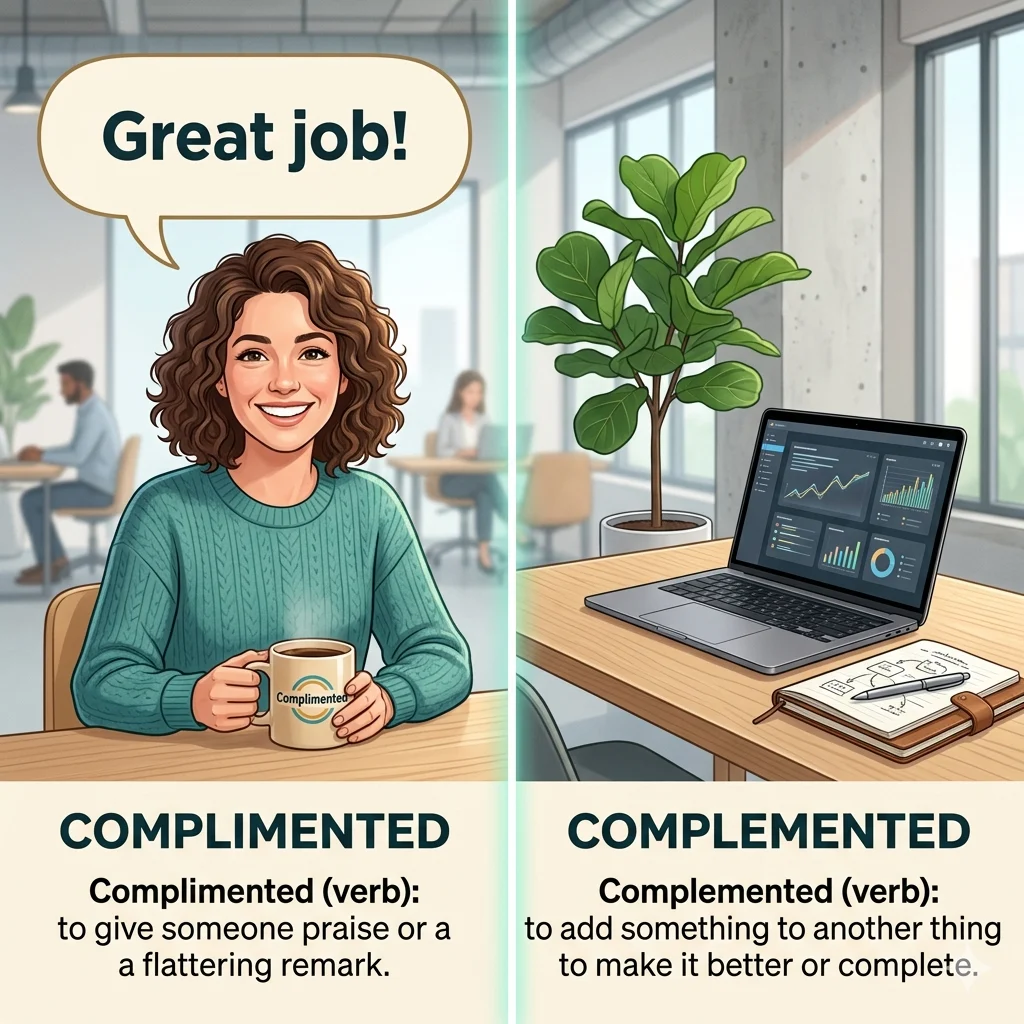
“Complimented means to praise someone, while complemented means to complete or enhance something; they sound similar but have different meanings.”
Confused between “complimented” and “complemented”? One small mistake can completely change your meaning! These two words may sound similar, but they have very different uses.
Complimented means to praise or say something nice about someone (“She complimented his outfit”), while Complemented means something that completes or enhances another thing (“The sauce complemented the dish perfectly” or “Her skills complemented the team”).
Using the wrong word can lead to confusion, especially in professional or academic writing. In this guide, you’ll not only learn the clear difference between complimented vs complemented, but also discover an easy trick to remember it forever.
If you want to write clearly, avoid mistakes, and sound more confident, understanding this difference is essential.
Complimented or Complemented meanings
The quick answer is that both words are correct, but they mean different things. Complimented (with an “i”) means to give praise or express admiration. If you tell someone they look nice, you have complimented them. Complemented (with an “e”) means to complete something or to make it better by adding to it. If a red tie brings out the colors in a blue suit, the tie complements the suit. Think of the “i” in compliment as “I” like praise for yourself. Think of the “e” in complement as “extra” or “complete.” For example: “She complimented his cooking” versus “The wine complemented the cheese.” Understanding this simple difference is the first step to mastering what is the difference between compliment and complemented.
The Origin of Complimented or Complemented
The confusion between complimented and complemented dates back hundreds of years. Both words share a common Latin root: complēre, which means “to fill up” or “to complete.” From this root, the English language developed two separate paths. The word complement stayed closer to the original Latin meaning. It entered English in the 14th century, referring to something that completes or makes perfect.
Compliment, however, took a different route. It came through French and Italian, where it evolved to mean the “ceremonious act of politeness” or “fulfilling the formalities of respect.” Over time, it shifted to mean flattering remarks or praise. So, while the words share a genetic link in history, they branched off to serve different purposes. The spelling difference exists because English borrowed words from different sources at different times. One word kept the “e” from the Latin root, while the other adopted an “i” through its journey in Romance languages.

British English vs American English Spelling
When it comes to complimented and complemented, the spelling rules are the same on both sides of the Atlantic. Unlike words like color (US) and colour (UK), these two words do not change spelling based on region. However, the frequency of usage can differ slightly. British English tends to use complement more often in formal contexts, particularly in art and architecture reviews. American English uses both words frequently in business and casual writing.
The confusion is universal. The spelling difference relies entirely on meaning, not geography. Whether you are in London or New York, complimented always relates to praise, and complemented always relates to completion.
| Word | Spelling Rule | Meaning | British English Usage | American English Usage |
|---|---|---|---|---|
| Complimented | Contains “i” (like “I”) | Gave praise | Common in social settings | Common in business/casual |
| Complemented | Contains “e” (like “extra”) | Completed or enhanced | Formal/technical use | Formal/technical use |
Which Spelling Should You Use?
Choosing between complimented and complemented depends entirely on what you are trying to say. If you are writing for a US audience, you will use both words frequently, so clarity is key. If you are writing for a UK or Commonwealth audience, the same rules apply, but you might see complemented more often in descriptions of scenery or food.
For global audiences, the advice is simple: check your intent. Are you praising someone? Use complimented. Are you describing how two things work together? Use complemented. If you are writing a professional email and you want to acknowledge a colleague’s work, you would say, “I complimented her on the presentation.” If you are writing a marketing piece about a product bundle, you would say, “The software complemented the hardware perfectly.” To test your understanding, try a complimented or complemented quiz online, or simply remember the golden rule: people get complimented; things get complemented.
Common Mistakes with Complimented or Complemented
The most common mistake is using one word when you mean the other. This usually happens because writers rely on spell check. Spell check will not flag either word because both are spelled correctly. For example, writing “He complemented her dress” is a frequent error. Since you cannot “complete” a dress with words, the correct word should be “complimented” (praise).
Another common mistake is in business writing. A manager might write, “Your skills compliment the team well.” This is incorrect because skills do not offer praise; they add value. The correct sentence is, “Your skills complement the team well.” Additionally, people often confuse the nouns. “I gave her a complement” is wrong; it should be “compliment.” Remember to look for context. If you are unsure, ask yourself: Is this about praise or about fitting together? Understanding how do you use complement and compliment in a sentence correctly prevents these embarrassing errors.

Complimented or Complemented in Everyday Examples
Seeing these words in real-world contexts helps solidify the difference. Here is how they appear in various types of writing.
Emails: In a professional email, you might say, “I just wanted to say I complimented your work to the director.” Or in a collaborative email, “I think this new design complemented the original concept well.”
News: News articles use these words carefully. A fashion critic might write, “The designer complemented the structured blazer with soft silk trousers.” A human-interest story might state, “The mayor complimented the first responders for their bravery.”
Social Media: On social media, the confusion is rampant. A user might post, “My new bag compliments my shoes.” Grammar-savvy followers will quickly point out that the bag complements the shoes (matches well), though the followers might compliment the user (give praise). You will often see hashtags like #PerfectlyComplemented for home decor or #Complimented for friendship posts.
Formal Writing: In academic or formal writing, precision is required. A thesis might say, “The findings of the first study complemented the results of the second.” A formal letter of recommendation might say, “I complimented his ability to manage complex tasks.”
To use these in a sentence correctly, always check the context. For complimented or complemented examples, look at the relationship between the subjects. If it’s a person speaking to another, it’s complimented. If it’s an object enhancing another, it’s complemented.

Complimented or Complemented – Google Trends & Usage Data
Analyzing search data shows that confusion over complimented or complemented spikes at specific times of the year. Searches for “what is the difference between compliment and complemented” often increase in January (back-to-work writing) and during the summer wedding season, where people are writing cards or describing outfits.
Geographically, the United States has the highest search volume for “is it complimented or complemented,” followed by the United Kingdom and Australia. Interestingly, search data reveals that people are more likely to search for the complimented spelling when looking for social etiquette advice, while searches for complemented often relate to interior design, fashion, and cooking. In the business world, searches for “complemented by” are rising, indicating that professionals are becoming more conscious of using the correct term in project proposals and team feedback.
Comparison Table: Complimented vs. Complemented
| Feature | Complimented | Complemented |
|---|---|---|
| Spelling | Contains an “i” | Contains an “e” |
| Part of Speech | Verb (past tense) | Verb (past tense) |
| Primary Meaning | To give praise or admiration | To complete or enhance by addition |
| Common Context | Social interactions, feedback | Fashion, food, art, teamwork |
| Synonym | Praised, flattered, lauded | Enhanced, completed, matched |
| Example | She complimented his singing. | The spices complemented the soup. |
| Question to Ask | Am I saying something nice? | Does it fit well together? |
(FAQs)
1. What is the difference between compliment and complemented?
The difference is meaning. Compliment (or complimented) refers to praise. Complement (or complemented) refers to something that goes well with something else to make it better or complete. If you say, “I like your shoes,” you are giving a compliment. If you say, “Your shoes complement your bag,” you are saying they look good together.
2. How do you use complement and compliment in a sentence?
Use compliment when expressing admiration: “He complimented her on her hard work.” Use complement when describing how things work together: “The new curtains complement the living room furniture perfectly.”
3. Is there a word complimented?
Yes, complimented is a valid word. It is the past tense of the verb compliment. It means to have given praise. For example, “The teacher complimented the student on the essay.”
4. Is it correct to say compliments?
Yes, it is correct to say compliments. It can be a noun meaning praise (“She received many compliments”) or a verb (“He always compliments his staff”). Just be careful not to confuse it with complements, which means things that go together.
5. What is a good synonym for complimented?
Good synonyms for complimented include praised, flattered, admired, lauded, or commended. If you are looking for complimented or complemented synonym for complemented, synonyms include enhanced, completed, matched, or rounded out.
6. Is it complimented or complemented grammar trick?
A popular trick is to remember the “i” in compliment stands for “I” (as in “I like you”). The “e” in complement stands for “extra” or “enhance.” If you can replace the word with “praise,” use compliment. If you can replace it with “match” or “complete,” use complement.
7. Is there a quiz to test complimented or complemented?
Yes, many grammar websites offer a complimented or complemented quiz. Typically, the quiz will ask you to fill in the blank. For example: “The colors of the sunset ______ the calm ocean.” The answer is complemented because it describes how they look together.
8. Can you use compliment and complement in the same sentence?
Yes, you can. For example: “She complimented him on how his tie complemented his suit.” In this sentence, she gave praise (complimented) about how well the items worked together (complemented).
Conclusion
Mastering the difference between complimented and complemented is a simple but powerful way to improve your writing. We have seen that the confusion stems from a shared Latin history but split into two distinct meanings. Complimented is all about praise—the kind words you give to people. Complemented is about completion—how things work together to create a better whole. By using the tricks provided, such as the “I” for praise and the “E” for extra, you can avoid the common mistakes that plague writers.
Whether you are writing an email, a social media post, or a professional report, taking the time to choose the correct word shows attention to detail and respect for your reader. Remember to look at the context. If you are talking about a person and admiration, use complimented. If you are talking about items or concepts that fit well, use complemented. Now that you understand the rules, you can write with confidence, knowing you are using the right word every time.

“Shena Mackay offers gentle, faith-centered reflections on Praydrop, inspiring readers with hopeful guidance, spiritual clarity, and heartfelt wisdom.”