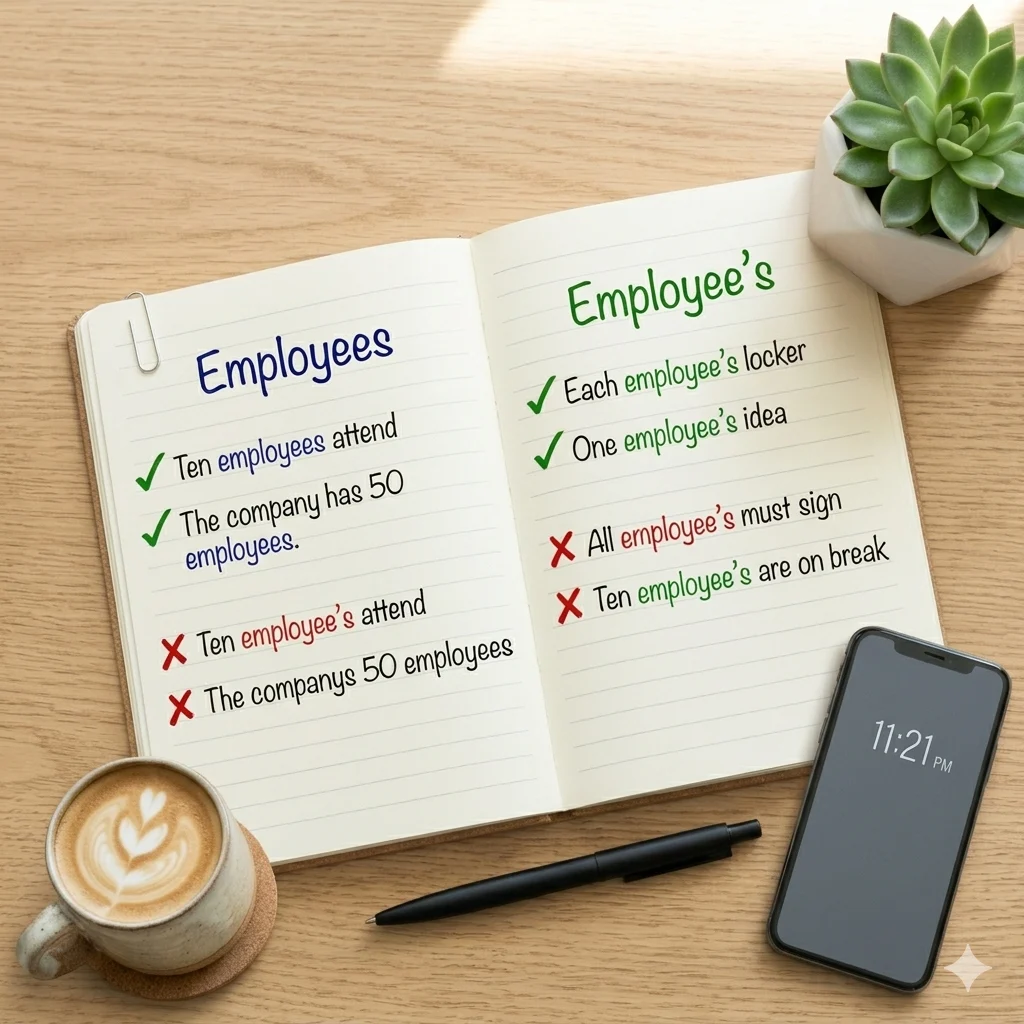
“Employees is plural, employee’s shows possession for one person, and employees’ shows possession for more than one; using them correctly keeps your writing professional.”
Confused between ‘employees’, ‘employee’s’, and ‘employees’’? One small apostrophe mistake can completely change the meaning of your sentence — and make your writing look unprofessional. Here’s the simple breakdown:
- Employees → plural of employee (more than one worker)
Example: “The employees are attending the meeting.” - Employee’s → singular possessive (something belongs to one employee)
Example: “The employee’s desk is very organized.” - Employees’ → plural possessive (something belongs to more than one employee)
Example: “The employees’ workstations were newly arranged.”
Understanding these forms is essential for clear, professional, and grammatically correct writing. In this article, you’ll learn all the rules, easy examples, and common mistakes to avoid so you never confuse these forms again.
Whether you’re writing emails, reports, or social media posts, knowing employees vs employee’s vs employees’ ensures your message is precise and professional.
Employees or Employee’s meanings
The difference is simple. It depends on whether you are talking about one person, many people, or something that belongs to them.
- Employee (singular): One person. Example: The employee is working hard.
- Employees (plural): More than one person. Example: The employees are working hard.
- Employee’s (singular possessive): Something belonging to one person. Example: The employee’s desk is clean.
- Employees’ (plural possessive): Something belonging to many people. Example: The employees’ lounge is being renovated.
If you are just talking about a group of people, use employees (no apostrophe). If you are talking about something that belongs to them, you need the apostrophe.
The Origin of “Employee”
To understand the word, it helps to look back at where it came from. The word “employee” comes from the French word employé, which means “a person employed.” English borrowed this word from French hundreds of years ago.
Because of its French roots, the spelling has always been a little tricky for native English speakers. The base word is “employ,” but we add “-ee” at the end to show the person who receives the action. For example:
- An employer is the person who gives the job.
- An employee is the person who receives the job.
The spelling difference often confuses people when they try to make it plural. Since it comes from French, some people mistakenly think the plural should be “employes” (like in French), but in modern English, we always add an “s” to make it employees.

British English vs American English Spelling
Here is the good news: there is no fight between American and British English on this word. Both sides agree.
- American English: Uses employee (singular) and employees (plural).
- British English: Uses employee (singular) and employees (plural).
The spelling is consistent across both major forms of English. The only difference might be in how the word is used in a sentence or in common phrases, but the core word is the same. However, when we add the apostrophe for possession, the rules stay the same in both dialects.
Here is a simple table to see the differences and similarities:
| Form | Spelling | Example Sentence | Usage Context |
|---|---|---|---|
| Singular | Employee | The employee of the month gets a bonus. | Talking about one person. |
| Plural | Employees | All employees must attend the meeting. | Talking about a group. |
| Singular Possessive | Employee’s | The employee’s laptop is new. | One person owns one thing. |
| Plural Possessive | Employees’ | The employees’ feedback was positive. | A group owns something. |
| Incorrect | Employes | The company has 20 employes. | This is a spelling error. |
Which Spelling Should You Use?
Your choice depends entirely on your audience and what you are trying to say. There is no “global” rule other than the grammar rule itself, but the context matters.
- If you are writing in the US or Canada: Use employees for plural and employee’s for possession. American business writing is very strict about apostrophe usage, especially in professional settings like resumes or company policies.
- If you are writing in the UK, Australia, or New Zealand: The rules are exactly the same. Use employees for the group and employee’s for the individual. Commonwealth countries follow the same standard English grammar rules regarding apostrophes.
- If you are writing for a global audience: Stick to the standard rules. Avoid using phrases that might be confusing, but know that employees and employee’s are universally understood in the English-speaking business world. Always double-check your apostrophes to ensure clarity.
Common Mistakes with Employees and Employee’s
Even native speakers make mistakes with this word. Here are the most frequent errors and how to fix them.
1. Using an apostrophe for plurals (The “Grocer’s Apostrophe”)
This is the most common mistake. People see an “s” and think they need an apostrophe.
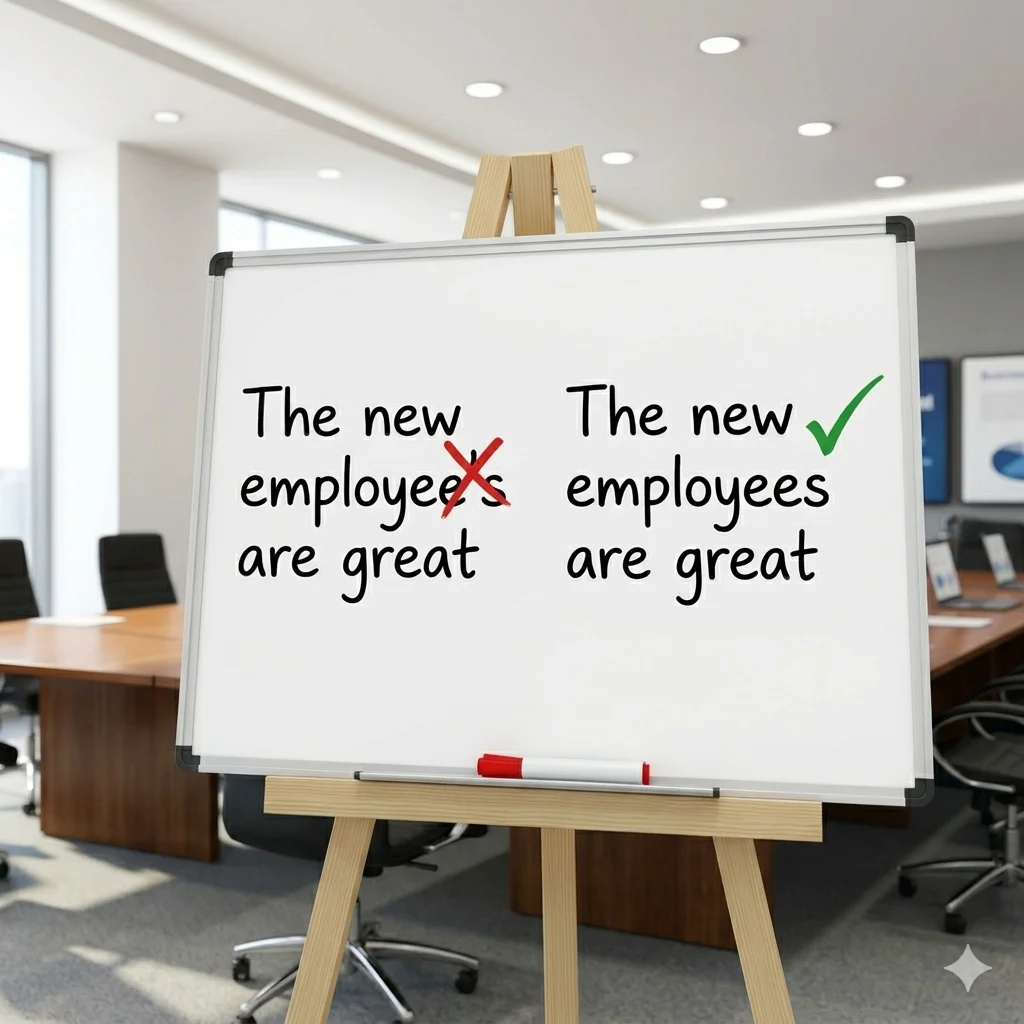
- ❌ Incorrect: The company hired five new employee’s.
- ✅ Correct: The company hired five new employees.
- Why? You are just talking about more than one person. There is no ownership, so no apostrophe is needed.
2. Confusing “Employees” and “Employers”
These two words are often mixed up in writing.
- ❌ Incorrect: The employers are asking for a raise.
- ✅ Correct: The employees are asking for a raise.
- Why? “Employers” are the bosses or the company. “Employees” are the workers. They are opposites.
3. Misplacing the apostrophe in possessives
Putting the apostrophe in the wrong spot changes the meaning.
- ❌ Incorrect: The employee’s lounge is for everyone. (This means the lounge belongs to one person).
- ✅ Correct: The employees’ lounge is for everyone. (This means the lounge belongs to all the workers).
- Why? If the lounge is for everyone, it belongs to the group (plural), so the apostrophe goes after the “s.”
4. Using “Employes”
You might see this spelling sometimes, but it is not standard in modern English.
- ❌ Incorrect: The list of employes is on the door.
- ✅ Correct: The list of employees is on the door.
- Why? The standard English spelling has two ‘e’s: employee.
Employees in Everyday Examples
Seeing the word used in different situations helps solidify the rule. Here is how it looks in real life.
In a Formal Business Email:
“Dear Team, I want to remind all employees that the deadline for timesheets is Friday. If you have not submitted your employee’s timesheet yet, please do so as soon as possible.”
On a Sign or Notice:
“Employees Only” (This means the area is just for the staff).
“Check the employees’ schedule for your shift.” (The schedule belongs to the group).
In a News Headline:
“Local Factory to Hire 50 New Employees.” (Plural, general statement).
“Employee’s Invention Wins National Award.” (Singular possessive, the invention belongs to one worker).
On Social Media:
“We are so proud of our employees! They worked hard on the charity drive.” (Plural).
“Happy birthday to Sarah! Check out the employee’s amazing cake!” (Singular possessive, the cake belongs to Sarah).
In a Company Policy Document:
“An employee’s personal data will be kept confidential.” (Singular possessive, the data of any one employee).
“All employees must complete the safety training.” (Plural, general requirement).

Employees – Google Trends & Usage Data
Looking at how people search for these terms reveals a lot about the confusion. Data shows that the word “employees” (the plural form) is searched for far more often than “employee’s” (the possessive). This makes sense because when people are writing about their staff, they are usually talking about the group.
- High-Volume Keywords: Phrases like “employees meaning,” “list of employees,” and “employees only” are very common. This tells us people are looking for definitions and practical usage.
- The “Apostrophe Question”: A huge number of searches are questions like “is it employees or employee’s” or “employees or employee’s grammar.” This is the main user intent—people are in the middle of writing and need a quick answer.
- Country Trends: The search volume for this question is highest in English-speaking countries like the United States, the United Kingdom, Canada, and Australia. In countries where English is a second language, the searches are more focused on the basic meaning rather than the advanced grammar of the apostrophe.
The data confirms that while “employees” is the more common word to use, the confusion between the plural and the possessive forms is a universal problem for writers at all levels.
(FAQs)
1. What is the plural form of worker?
The plural form of “worker” is workers. You simply add an “s.” It follows the same rule as “employee,” but without the tricky French spelling. For example: “The workers are on break.”
2. What is the plural form of a staff?
This is a special case. The word “staff” usually refers to a group of people. If you are talking about one group, it is “staff.” If you are talking about multiple groups from different companies, the correct plural is staffs. For example: “The staffs of both hospitals met for a conference.”
3. What is the plural form of employe?
The word “employe” is an outdated spelling of “employee.” If you were to use it, the plural would logically be “employes.” However, this is not recommended. The correct modern spelling is employee (singular) and employees (plural).
4. What does employes mean?
“Employes” is a common misspelling of “employees.” It is meant to mean more than one worker. However, because it is misspelled, it is considered grammatically incorrect. The correct word to use is employees.
5. Which is correct: employees or employee’s?
Both are correct, but they mean different things. Use employees when you mean more than one worker. Use employee’s when you mean something belongs to one worker. For example: “The employees are happy because the employee’s suggestion box was successful.”
6. Is it “employees or employee’s” for a sign?
It depends on the sign. If the sign says “Employees Only,” that is correct because it means “Only Employees (people) are allowed.” If the sign is about a parking lot that belongs to the staff, it should say “Employees’ Parking” (plural possessive).
7. What is the difference between employees and employers?
Employees are the people who work for a company. Employers are the people or the company that hires the workers. For example: “The employer expects the employees to arrive on time.”
Conclusion
Mastering the difference between employees and employee’s is a small detail that makes a big impact on your professional writing. The key takeaway is to ask yourself a simple question: “Am I talking about many people, or am I talking about ownership?” If you are talking about a group, skip the apostrophe and use employees.
If you are talking about something that belongs to one person, add the apostrophe before the “s” to make it employee’s. If the whole group owns something, put the apostrophe after the “s” to make it employees’. By remembering this one simple rule, you can avoid common grammar mistakes and ensure your emails, reports, and signs are clear, correct, and professional. Whether you are writing for an American company or an international audience, using the right form shows that you care about the details.

“Shena Mackay offers gentle, faith-centered reflections on Praydrop, inspiring readers with hopeful guidance, spiritual clarity, and heartfelt wisdom.”