
“Fertiliser (British English) and fertilizer (American English) are two spellings of the same word that describe a substance used to improve plant growth.”
Ever noticed both “fertiliser” and “fertilizer” and wondered which one is correct? The answer is simple—both spellings are correct and refer to the same substance used to enrich soil and support plant growth by providing essential nutrients.
The difference lies only in regional English usage. Fertiliser is the preferred spelling in British English, while fertilizer is commonly used in American English. For example, in American English you might write, “The farmer applied fertilizer to improve crop yield,” whereas in British English you could write, “Organic fertiliser is widely used in sustainable farming.”
Choosing the right spelling depends on your target audience and the version of English you are following. Understanding this difference helps you maintain consistency, improve clarity, and write more professionally in your content.
Fertiliser or Fertilizer meanings
The quick answer is that both spellings are correct. They mean the exact same thing: a natural or chemical substance added to soil to help plants grow.
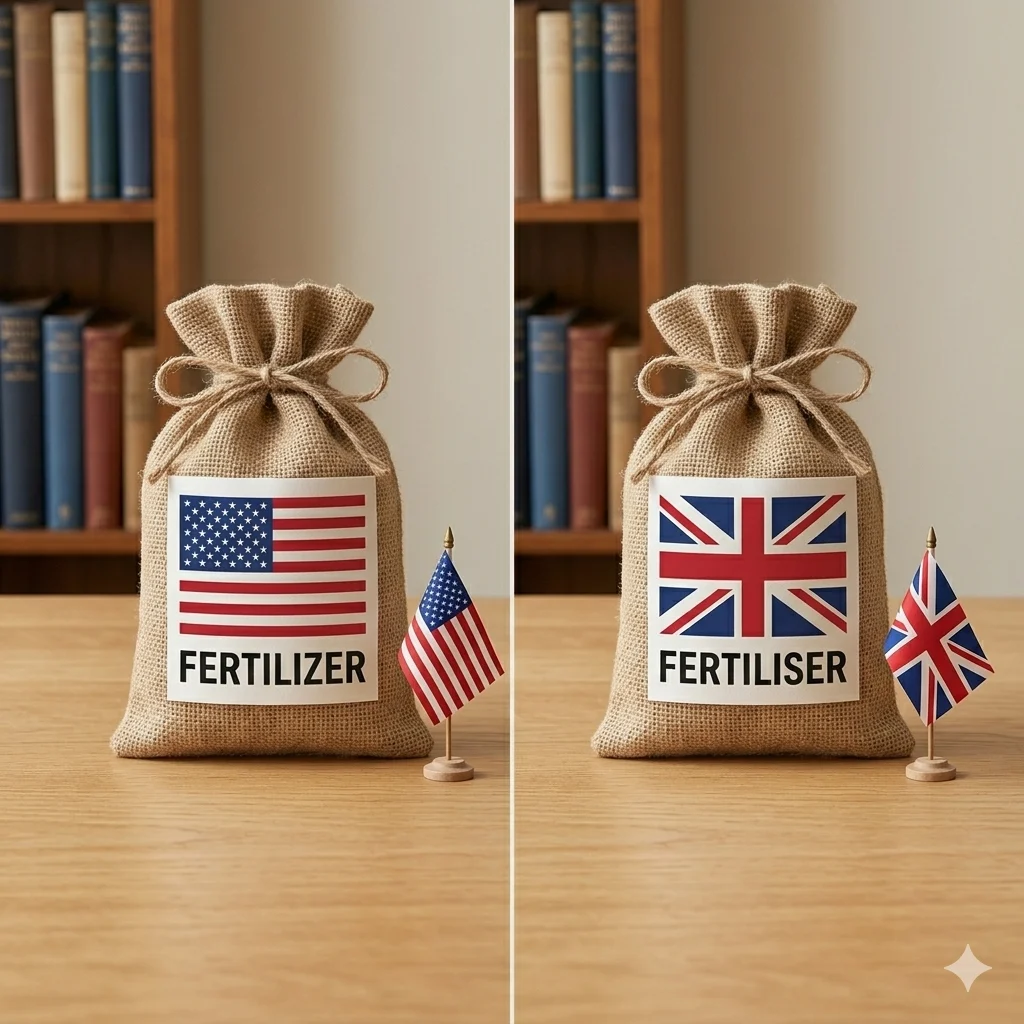
- Fertilizer (with a ‘z’) is the standard spelling in the United States and the Philippines.
- Fertiliser (with an ‘s’) is the standard spelling in the United Kingdom, Australia, New Zealand, Canada, and most other English-speaking countries.
Examples:
- US: The farmer spread fertilizer on the cornfield.
- UK: The gardener bought organic fertiliser for the roses.
So, if you are writing for an American audience, use “z.” If you are writing for a British or Australian audience, use “s.”
The Origin of Fertiliser
The word comes from the Middle French word ‘fertile’ , which means “bearing fruit.” The English word ‘fertile’ appeared in the 15th century. To make the verb, we added ‘-ize’ or ‘-ise’.
For a long time, English spelling was not fixed. In the 17th and 18th centuries, as science grew, the need for new words grew too. Many scholars took words from Greek and Latin. They often used the Greek ending ‘-izo’ to make verbs. This is why we have words like “organize” and “civilize.”
However, the French language influenced English a great deal. The French version of these endings was often ‘-iser’ . So, both forms existed in British English for centuries. The big change happened in the 19th century. An American dictionary maker named Noah Webster wanted to simplify American English. He thought words like “colour” (colour) and “centre” (center) were illogical. He also pushed for the ‘-ize’ ending to become ‘-ise’ in some cases, but interestingly, he preferred the ‘-ize’ spelling for many verbs, which stuck in the US. Meanwhile, the UK kept both, but the ‘-ise’ ending became more common in everyday use.

British English vs American English Spelling
This is the core of the fertiliser or fertilizer debate. The difference is part of a larger pattern in English spelling.
In American English, the suffix -ize is almost always used to form verbs from nouns or adjectives. In British English, you can technically use both, but -ise is much more common in standard writing and publications.
Here is how the spelling rules work:
- American English Rule: Use -ize for verbs like realize, apologize, and organize. Therefore, it is fertilizer.
- British English Rule: While the Oxford English Dictionary prefers -ize (as it is closer to the Greek root), the standard for newspapers, schools, and the government is -ise. Therefore, it is fertiliser.
Let’s look at a comparison:
| Word | American Spelling (US) | British Spelling (UK/Australia) |
|---|---|---|
| Plant Food | Fertilizer | Fertiliser |
| To make aware | Realize | Realise |
| To say sorry | Apologize | Apologise |
| To put in order | Organize | Organise |
| A type of business | Organization | Organisation |
As you can see, once you know the rule for fertiliser or fertilizer, you know the rule for dozens of other words.
Which Spelling Should You Use?
Choosing the correct spelling depends entirely on who you are writing for. This is a simple choice based on your audience.
- For a US Audience: Always use Fertilizer. If you are writing for a company in New York, a US school, or an American blog, use the ‘z’. Using the ‘s’ might look like a typo to them.
- For a UK, Australian, or NZ Audience: Always use Fertiliser. If you are writing to a customer in London or a farmer in Sydney, use the ‘s’. Using the ‘z’ might make you look uneducated in local spelling norms.
- For a Global Audience (like the internet): You have two choices. You can pick one and be consistent. Many global companies use US English because it is often the standard for technology and science. However, if your content is about gardening in the UK, use UK English.
The most important rule is consistency. Do not write “fertiliser” in one sentence and “fertilizer” in the next.
Common Mistakes with Fertiliser
Even though the spelling difference is simple, people make mistakes. Here are the most common errors to avoid.
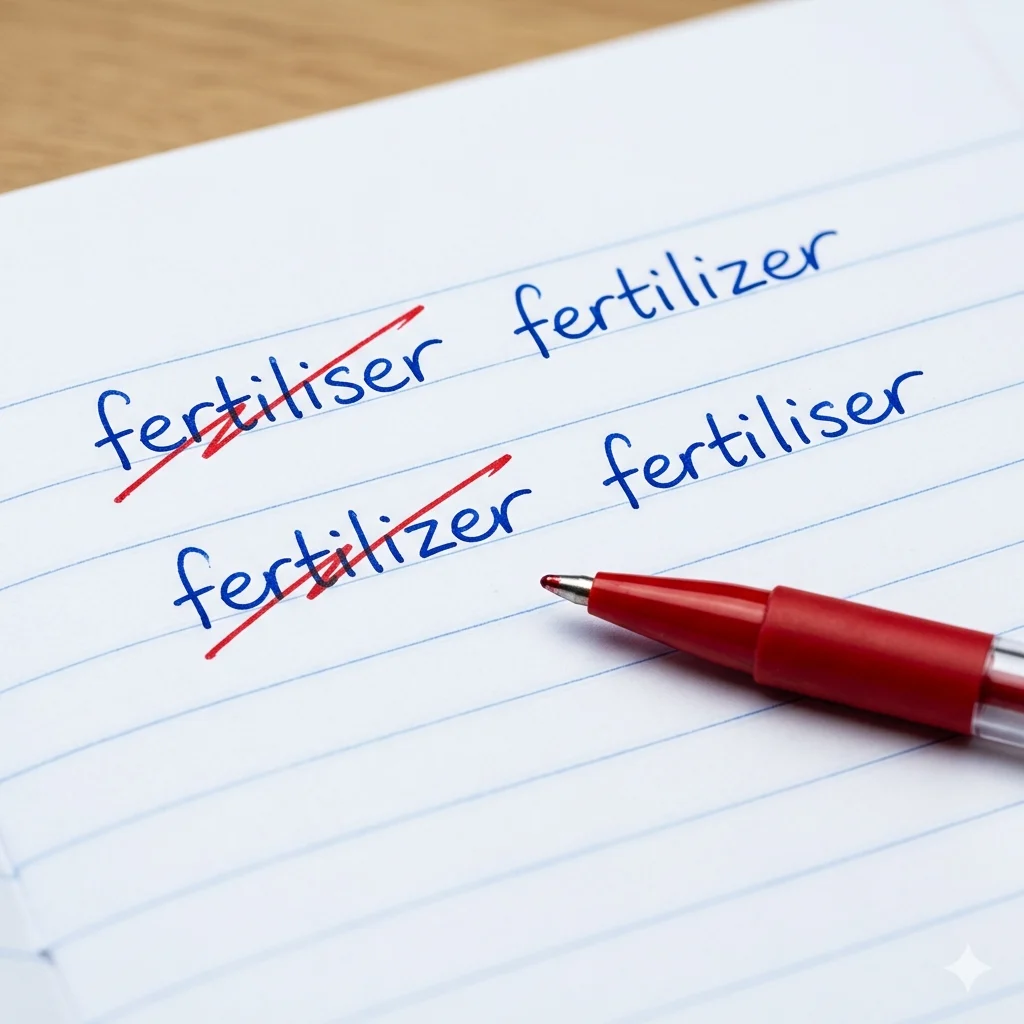
- Mixing Spellings: This is the biggest mistake. For example: “We need to buy fertilizer for the garden, but this organic fertiliser is better.” This looks unprofessional. Pick one style and stick to it throughout your entire document.
- Using the Wrong Spelling for the Audience: If you are applying for a job at a British farming magazine, using “fertilizer” in your cover letter might hurt your chances. It shows a lack of attention to detail regarding their local English.
- Confusing it with “Fertile”: Sometimes people misspell it as “fertile-izer” or “fertiler”. Remember, the base word is ‘fertile’, but the suffix attaches to make fertilizer.
- Spelling it “Fertiliser” in US Brand Names: If you are naming a product to be sold in the US, spell it with a Z. If you are selling in the UK, spell it with an S.
- Assuming One is Wrong: Remember, neither is incorrect. It is just geography. Don’t correct someone online for using the ‘s’ spelling if they are from the UK.
Fertilizer in Everyday Examples
Seeing the word in different contexts helps you remember when to use which spelling.
In a Formal Report (UK):
“The application of nitrogen-based fertiliser has increased crop yields by 15% this quarter.”
In a News Article (US):
“The governor announced new subsidies for local farmers to purchase corn fertilizer before the spring planting season.”
On Social Media (Australia):
“Just picked up some amazing organic fertiliser for my veggie patch! #GardeningAustralia”
In a Business Email (Global Company):
“Dear Team, please review the safety data sheet for the new granular fertilizer we will be distributing in the North American region.”
In a Gardening Blog (Canada):
“Fertiliser is key to big blooms. For roses, you want a balanced mix.”
Fertilizer – Google Trends & Usage Data
If you look at search data, you will see a clear geographical split that matches the spelling rules we discussed.
- In the United States: The search term “fertilizer” (with a ‘z’) dominates. It is used by farmers, gardeners, and companies. When someone in the US searches for What fertilizer is good for oil palms? they will type it with a ‘z’.
- In the United Kingdom and Australia: The search term “fertiliser” (with an ‘s’) is more common. A gardener in Melbourne looking for What is the best fertilizer for kale? will likely type it with an ‘s’.
Data shows that globally, “fertilizer” (z) has a higher search volume simply because the population of the United States is large, and US English is dominant in global online content. However, in Commonwealth countries, the local preference for ‘s’ is very strong.
Interestingly, scientific journals often have their own style guides. Some prefer the ‘-ize’ spelling regardless of the country because of the connection to classical roots. But for general use, the geographical rule is your best guide.
FAQs
1. Which is correct, fertilizer or fertiliser?
Both are correct. “Fertilizer” is the standard spelling in American English. “Fertiliser” is the standard spelling in British English and other varieties of English, such as Australian and Canadian English.
2. What do you mean by fertiliser?
Fertiliser (or fertilizer) means any material of natural or synthetic origin that is applied to soil or plants to supply essential nutrients. These nutrients, like nitrogen, phosphorus, and potassium, help plants grow faster and healthier.
3. Is it fertiliser or fertilizer in the UK?
In the United Kingdom, the correct spelling is fertiliser (with an ‘s’). This follows the common British practice of using the ‘-ise’ suffix for verbs.
4. Is it fertiliser or fertilizer in Australia?
In Australia, the correct spelling is fertiliser (with an ‘s’). Australia follows British English conventions for these types of words.
5. What fertilizer is good for oil palms?
Oil palms need a balanced mix of nutrients. A fertilizer high in potassium and magnesium is often recommended. You should look for a specific NPK (Nitrogen, Phosphorus, Potassium) blend designed for fruit trees or palms. Remember to use the local spelling when searching: “fertilizer” in the US, “fertiliser” in Malaysia or Africa (which often follow British English).
6. What is the best fertilizer for kale?
Kale is a leafy green, so it needs a fertilizer high in nitrogen to support leaf growth. Organic options like composted manure or blood meal are great. For chemical types, a balanced fertilizer like a 10-10-10 mix applied halfway through growth works well. Search using your local spelling.
7. Why are there different spellings for the same word?
The different spellings come from historical changes in the English language. American English was standardized by Noah Webster, who favored simpler and more phonetic spellings. British English retained older forms and was more influenced by French spellings.
8. Is it wrong to use “fertilizer” in the UK?
It is not strictly “wrong,” and people will understand you. However, in formal writing, publishing, or academic work in the UK, using the American spelling “fertilizer” would be considered a spelling error. It is always best to follow the local convention.
Conclusion
The great debate over fertiliser or fertilizer is easy to solve. It is not a question of grammar, but of geography. We learned that both words describe the same vital product for plant growth. The difference comes from the history of English and the preferences of different countries. If you are in the United States, you use a ‘z’. If you are in the United Kingdom, Australia, or New Zealand, you use an ‘s’.
The key takeaway is to know your audience. Before you write, think about who will read your text. If you are writing for an international audience, pick one style—usually US English is safer for global tech platforms—and be consistent. Do not mix the two. Whether you are researching types of fertilizers used in agriculture or explaining the importance of fertilizers to a student, using the correct spelling for your reader shows professionalism and care. Now you can write with confidence, knowing that you have the right spelling for the right reader.

“Machin Smith writes faith-driven reflections for Praydrop, offering readers clarity, hope, and spiritual wisdom for a grounded, meaningful life.”